
Let's (Talk) Neck

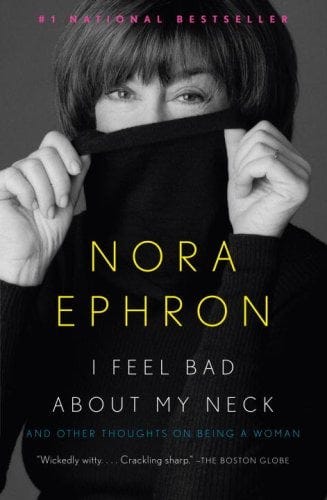
Nora Ephron wrote in her book, “I Feel Bad About My Neck: And Other Thoughts on Being a Woman,” about the challenges of aging. She layered this with the societal and ultimately personal pressures on a woman to maintain a youthful appearance, focusing on the surface changes in one’s neck as the banner for having become a “woman of a certain age.”
The thesis of her book led her into some essential life questions: “Do you splurge or do you hoard? Do you live every day as if it’s your last, or do you save your money on the chance you’ll live twenty more years? Is life too short, or is it going to be too long? Do you work as hard as you can, or do you slow down to smell the roses?
And where do carbohydrates fit into all this? Are we really all going to spend our last years avoiding bread, especially now that bread in America is so unbelievable delicious? And what about chocolate?”
Let’s face it. Nora Ephron had a point.
Clearly, she leaned into humor as the antidote to how we feel about aging, particularly when it comes to the state of one’s neck. She wrote, “According to my dermatologist, the neck starts to go at forty-three, and that’s that. You can put make-up on your face and concealer under your eyes and dye on your hair; you can shoot collagen and Botox and Restylane into your wrinkles and creases. But short of surgery, there’s not a damn thing you can do about your neck.”
“And our faces are lies, while our necks are the truth.”
She was kinda suggesting we need to get in all our “necking,” the practice of kissing and caressing the neck, before turning 40.
As the evidence of aging surfaces, we try to hide it behind turtlenecks. But not mock turtlenecks. They call them “mock” because they do just that. Mock you. Rather than hide the succulence that has slid right off your face and onto your neck, they draw attention to, feature the indiscretions of time.
Now turtlenecks, they do their job. Diane Keaton swore by them. Except, of course, in the heat of the moment of passion with her daughter’s “boyfriend,” when she urged Jack Nicholson to cut off the turtleneck that lay between her and the confirmation that sex in your sixties can be pretty darn, well, hot.
During a recent visit with my dermatologist, whose own ethnic heritage means lasting beauty is a birthright, she actually said my list of concerns were out of her jurisdiction. Then she showed me a laminated flip book pairing mother-daughter photos to help explain how and why things, well, shift.
Think Sir Isaac Newton. Gravity. We paused for a moment of silence while I absorbed the gravity of her message.
Last night, when I went to sleep, I was thirty. Forty, tops. This morning, I work up, not to my mother in the mirror—she was beautiful, her skin a natural “after picture” the whole ride. No, I woke up to see her mother, if not her mother’s mother. And I’m not talking about those adorable tintype photos when they were darling children wearing enormous bows in their hair and high-button shoes, or the wedding photos where someone must have told them it was gauche to smile. I mean, as I remember them, late in their story.
One of my girlfriends told me the way to solve this angst is to never look in the mirror again. Ever. And load up on those turtlenecks. And scarves. A kaleidoscope of scarves.
My husband simply said, “You’re beautiful.” And there it is. We get to choose what and who we listen to and how it makes us feel, don’t we. Even with regard to our own inner voice.
Scarves! Of course! Permission for a drawer full of colorful, luxurious scarves. It not only mitigates the issue; it's elegance. Just like dancer Isadora Duncan. Okay, maybe not Isadora Duncan. That didn't end well.
Love this and so true. I had to face the neck thing after I had surgery on my C5 10 years ago when I turned 60. The surgeon went in through my neck. My answer a closet full of beautiful scarves and a husband who tells me I’m beautiful. I’m trying to make peace with the aging wrinkle, creepy skin. Veins, determined to find the beauty of a body well lived and loved.